A surf hat is the only piece of gear you wear every single session. Not the wetsuit — you skip it in summer. Not the helmet — it stays in the car. A hat that actually stays on, you’ll wear every time. Worth choosing properly.
Here’s what actually matters, what’s on the market, and how to decide.
The four things that matter
1. The chin strap — the one non-negotiable
A hat with no chin strap is gone on the first duck dive. This isn’t a comfort feature, it’s what decides whether you come back in with your hat or without it.
Look at two things: the adjustment — it has to work one-handed, in the water, with cold fingers — and the anchor point. A strap sewn flat onto the brim pulls badly; one anchored to the crown pulls straight.
2. The brim — soft, stiff, or in between
A soft brim collapses over your eyes the moment it’s wet. Too stiff and it catches wind like a sail and yanks your head sideways when you’re carrying your board.
The right compromise stands up wet but folds under your hand. Aim for 6–8 cm: less and you don’t cover your neck, more and you can’t see the wave coming.
3. Drying and flotation
Two different things, often confused. Fast-drying fabric saves you starting the next session with a cold, heavy hat on your head. Flotation saves you losing it if it does come off.
A hat that sinks is a hat you don’t get back. Check it — it isn’t standard.
4. Ears
The thing nobody checks when buying and everybody regrets later. A three-hour session is three hours of wind and cold water on your ears.
Ear cups cover the outer ear and cut wind. Be clear though: cups are not earplugs. They don’t seal the canal and don’t replace hearing protection. If surfer’s ear is a concern for you, keep your plugs — a hat with cups goes over them.
Soft hat or hat with an insert?
That’s the real question, and the answer depends on what you ride.
A soft hat protects you from the sun, which is already a lot. Light, forgettable, rolls into your bag. If you surf beach breaks in summer, that’s probably all you need.
A hat with an insert adds a rigid shell in the crown. It takes the hit from a board nose, a fin, a foil mast. It weighs a bit more. It costs more.
What it is not — and be wary of anyone who tells you otherwise: it’s not a helmet. For reef, shore break, shallow spots or foiling in size, you need a homologated EN 1385 helmet. No hat plays in that category — we go into more detail in our head safety in surf and foiling guide.
The standards, plainly
Three labels come up, and they don’t say the same thing.
UPF 50+ — the fabric’s sun protection. Says nothing about impact. It’s the only standard most surf hats claim.
EN 812 — the European bump cap standard. Covers striking your head against a hard, stationary object: your board, a fin, a mast. Does not cover high-energy impact.
EN 1385 — homologated watersports helmet. The only one that protects against a real impact.
Worth watching when you buy: some brands print « EN 812 certified » against the finished product, others against the insert alone. Those aren’t the same claim, and the difference is rarely spelled out. Ask what exactly the certification covers and which part was tested. A brand that can’t answer precisely deserves your suspicion.
The four families of surf hat
| Type | Typical price | Insert | What it does well | Where it falls short |
|---|---|---|---|---|
| Classic soft hat | €30–45 | no | Light, rolls into a bag, dries fast | Brim collapses once wet, no impact protection |
| Stiff-brim hat | €45–75 | no | Holds up in strong wind, clear sightline | Catches wind when carrying, bulky |
| Surf cap | €40–55 | no | Low profile, full field of vision | Neck and ears left uncovered |
| Hat with removable insert | €49–80 | yes | Takes everyday knocks, insert comes out | Heavier, more expensive |
Ranges observed on the European market in August 2026.
Two notes on that table. First, price tells you very little about quality in this category: there are excellent chin straps at €35 and poor ones at €70. Second, having an insert isn’t a mark of superiority — it’s a question of use. A hat with an insert bought for summer beach-break sessions is weight and money for nothing.
Which one, for how you ride
You just want to stop cooking in the sun. A soft hat with a good chin strap is enough, and you’ll find one under €40. Don’t pay for an insert you won’t use — ours included.
You surf regularly and you’ve already taken your board to the head. An insert earns its place. It’s one impact a season — but it’s the one you remember.
You foil or wing. Here it’s barely a question. The mast and wings are hard, thin and fast. Insert at minimum — and a real helmet as soon as it builds.
You ride reef or shore break. EN 1385 helmet. No hat, no insert, no debate.
Where the Txapel sits
Ours is a hat with an insert, at €49, and here’s exactly what it is.
The rigid insert is a JSP HardCap A1+, certified to EN 812. You can pull it out of the crown and read the marking on it — verifiable without taking our word for it. The certification belongs to that part, not to the assembled hat, and we’d rather write that than let you assume.
360° brim, mesh ear cups that let water drain, chin strap, one size 54–58 cm. Designed in the Basque Country.
What it isn’t: a helmet. For the days you need one, get a real one.
Shopping for a surfer or a foiler? Here are our gift ideas, sorted by budget.
Hat
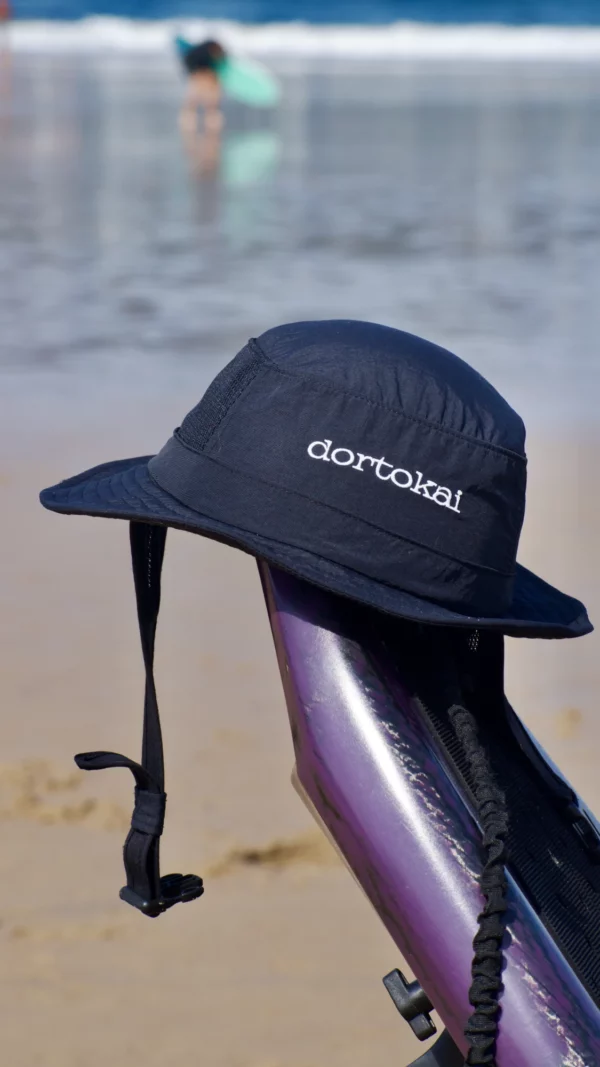
Txapel – Surf bucket hat
Surf bucket hat with a rigid insert certified to EN 812 — soft ear cups, 360° brim. Lightweight, fast-drying, unisex 54–58 cm.