When you get into foiling, you often grab the leash lying in the garage or on an old surfboard. A common mistake — and an understandable one: in our heads a leash is just a leash, so basic we don’t even think about it. Yet between a surf session and a foil session, the leash’s place changes completely. Here’s how to choose a foil leash suited to your practice, so you can stay focused on your session — and nothing else.
Foiling isn’t surfing
In surfing as in foiling, there are two key phases: the take-off and the ride.
In surfing, the take-off usually happens on a still-unbroken, clean wave. Once you’re up, the board glides on the water’s surface. The leash has a simple job: keep the board from getting away from you after a fall, and let you climb back on as fast as possible to reposition for the next waves.
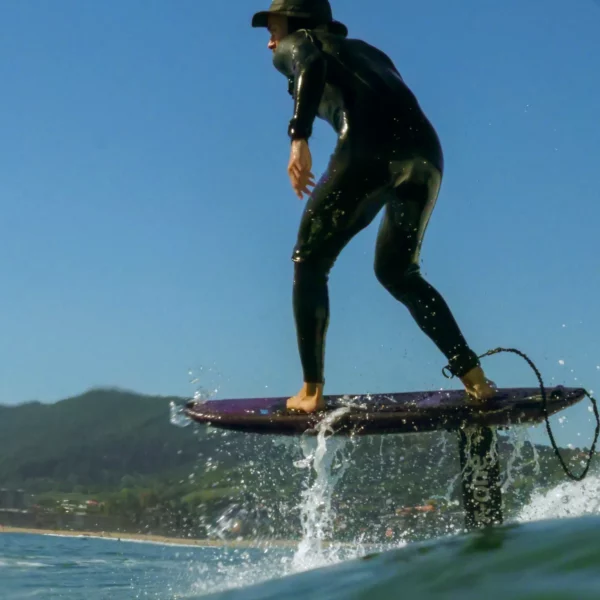
In foiling, the leash has the same job, but its presence is another story. The take-off usually happens in the whitewater, for a slower start and optimal control of the foil. There are already plenty of parameters to manage at that crucial moment: nothing should get in the way of your focus.
Once you’re past the take-off, in surfing as in foiling, the goal is to ride the wave as long as possible. Foiling adds an extraordinary possibility: leaving one wave and connecting to others without paddling back and taking off again, climbing back to the peak by pumping. Pumping is a long technique to master — it takes patience and determination — but the satisfaction is unmatched. What’s better than linking 3, 4, 5… even 8 waves without stopping?
We all know surf leashes, chosen by board size. But foiling involves many other parameters to weigh when choosing your leash, to keep your effort and focus on what matters most: the ride.
Go for a short foil leash
A classic surf leash is roughly as long as the board it equips, from 5’5 to 8’0 or more. That length keeps some distance between the surfer and the board during a fall, since the board is light and easily tossed around by the waves.
In foiling, that length is a problem, for several reasons. With the mast-and-foil combo under your feet, a leash that long has every chance to slip in and snag on your foil — frustrating when it happens mid-set and you miss the waves.
Length also gets in the way during the ride and pumping: flying above the water, a long leash inevitably ends up touching the surface, bouncing, dragging, and creating an unpleasant feeling. A shorter leash doesn’t touch the water, or barely, and frees you from that nuisance so you can focus on your turns and your pumping.
Go for a flat foil leash
In surfing, you rarely move around on the board — except for our longboarder friends. Once you’ve found your stance, you hold it and finish the wave in that position: no foot repositioning, no obstacle.
In foiling, managing your height above the water demands constant adjustment of your position and centre of gravity. It is common to use foot and body placement to fine-tune certain phases of the ride, like the wave exit that sets up pumping. These adjustments require moving confidently on the deck — where the leash can unfortunately end up. If you step on a classic leash, or worse a coil, while moving your feet, the discomfort is immediate and breaks your focus and precision.
A flat leash that ends up on the deck, near your feet, won’t bother you: its low thickness means that when you step on it you barely feel it, without losing balance, and you can carry on your adjustment sequence without a problem.
Go for a light foil leash
A classic surf leash means plastic, metal, weight, breaking points and maintenance. It works great for surfing.
Foiling is about minimum drag and maximum feel. You optimise weight and drag everywhere: the board, the mast (hello 12 mm UHM masts), the fuselage–wing–mast connections. So why drag along a heavy leash that weighs in the water? A light, hydrophobic leash cuts the overall weight of your gear and stays in line with that pursuit of less drag.
Classic leash or foil leash?
By now it’s clear: surfing and foiling are two close activities, but certain aspects of each set different priorities and equipment needs.
The classic straight surf leash is perfectly suited to its use. It meets the surfer’s needs, but it creates a lot of frustration for the foiler. There are versions adapted to foiling — the coil leash and the calf leash — which tick a few important boxes, but none fully eliminates the flaws:
- Coil leash: often shorter than a classic leash, but much thicker in return — stepping on it throws you off balance and a fall is almost guaranteed. The weight suffers too.
- Calf leash: inspired by the longboard calf leash, but shorter, straight or coiled. It only half-ticks the short-leash box, since some length margin is needed to clear the knee. And it repeats the classic leash flaws: stepping on it is unpleasant. A special demerit for the coiled calf leash, which has a huge tendency to wrap around itself and jam at take-off.
We tried everything, every kind of leash — and the verdict is clear: a product designed for foiling was missing, one that respects the foiler’s needs and lets them focus on what matters: enjoyment and progression.
Where the Lotura fits
The Lotura takes the foil logic all the way. Our brief: meet the three criteria above — short, light and thin (flat, even).
Short
125 cm long, 165 cm when extended.
- Designed not to snag on your foil.
- Designed to keep you comfortable in the water while you wait for the set.
- Designed not to create drag or bounce in flight.
Light
100% textile, zero plastic or metal. Hydrophobic: it doesn’t absorb water.
- Designed not to slow you down.
- Designed to spare you the maintenance.
- Designed so you don’t have to coil it to store it.
Thin
Flat, even.
- Designed not to get in your way.
- Designed so you feel at ease on your deck during foot moves.
Designed so you don’t have to think about it. Designed because we believe the best leash is the one you forget the moment you hit the water.
Shopping for a surfer or a foiler? Here are our gift ideas, sorted by budget.
Leash
Lotura – Surf foil leash
100% textile surf foil leash — no metal, no plastic. 125 cm long, 165 cm stretched. Short, light, flat.